Bee Facts
I’m about 5 weeks into my beekeeping journey. I will address some common questions up-front:
Q: Do you have bees?
A: No. I want to wait until I have land.
Q: Why are you doing this?
A: Something to learn! And I think it’d be cool to get into one day.
Q: Have you been stung?
A: Nope! The bees aren’t really out-and-about this time of year. It’s too cold.
I am about halfway through the class, and I have two lovely mentors. They are kindly teaching a small cohort, and in exchange, they’re locking in some trained labor for the busy season in May and June. Beekeeping involves a lot of heavy lifting, so many hands make light work!
I have a whole notebook of interesting bee facts, but I wanted to share some of my favorites.
-
Bees have these three dots arranged in a triangle shape on the top of their head called ocelli. Biologists have determined it’s useful for navigation, but their exact function is still pretty controversial/unknown.
-
The way bees flap their wings is so adorable. I was expecting something like a bird flapping its wings, but it’s actually more like their whole body is squishing and squashing.
I made a very scientific illustration of how it works:

-
If you move a hive only a short distance (like 20 feet), many foraging bees will return to the old location and get lost. But if you move a hive a long distance (typically 2+ miles), the bees reorient and learn the new surroundings, so they can successfully navigate back to the hive.
Bees memorize the landscape around their hive. Small moves keep the environment “close enough” to confuse them, while large moves force a full reset of their navigation.
Note: bees that were already out foraging during the move may still be lost. -
Honeybees will happily accept productive foragers from other bee colonies into their own hive as one of their own. This behavior can depend on season (autumn is more cutthroat as supplies dwindle), but if a forager is productive and smelling of nectar and pollen, it'll be welcomed into the hive. Even if it wasn't born in that hive.
Seems like we can learn a lot from them. -
You can just buy 3 pounds of bees and have it shipped to you via USPS. In fact, you can buy quite a lot of livestock via USPS. You can buy an emu chick?!
-
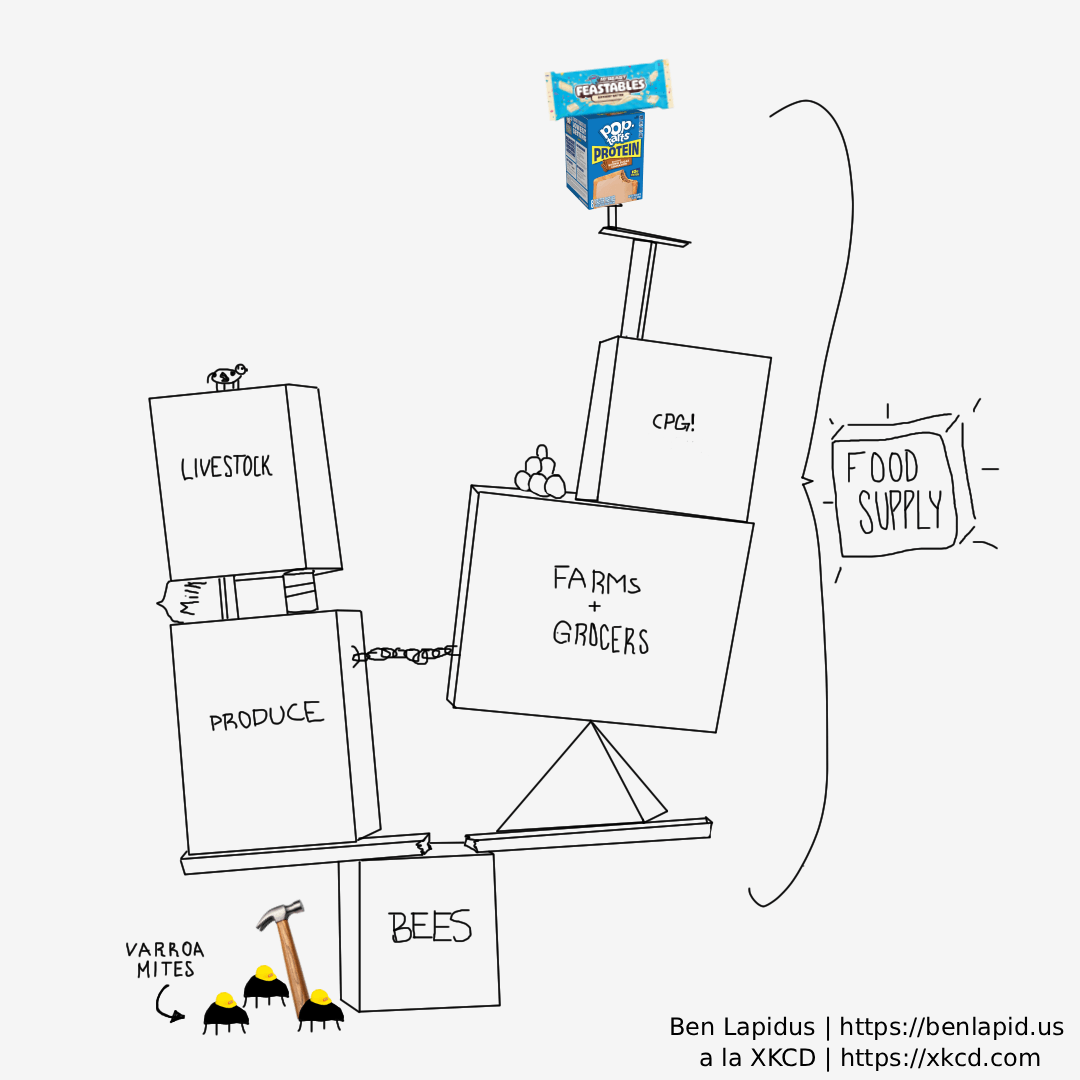
Varroa mites are a humongous problem for beekeepers, and, like, the whole food network?! From 2019 to 2020, beekeepers reported a 43% colony loss. And these mites only became a problem in the 70's and 80's. This is recent history!
-
Bees communicate with each other using a series of dances. Waggle dances can communicate nectar sources that are far away, and round dances can communicate sources that are close by. Shake dances request more foragers. And tremble dances communicate that there's a big ol' load of nectar coming in -- stop foraging and come help receive the load!